Kedify at KubeCon 2026: Explore autoscaling and rightsizing with our team
 All Posts
Kedify Advances Kubernetes Efficiency and Autoscaling for Large Platforms
by Kedify Team
November 09, 2026
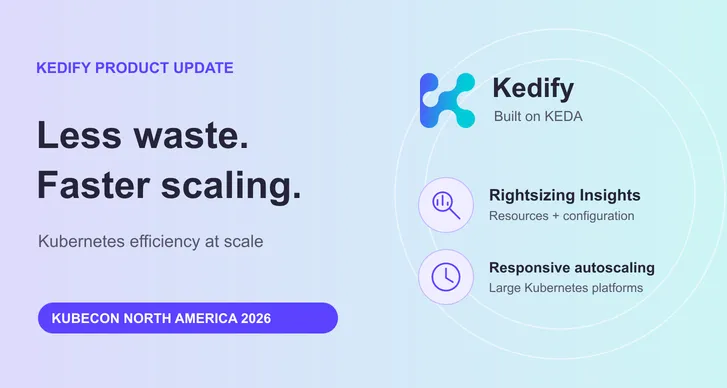
Expanded Insights helps teams reduce resource waste and manual tuning by optimizing resource allocation and autoscaling configuration
SALT LAKE CITY, November 9, 2026: Kedify, the Kubernetes autoscaling company built by core maintainers of KEDA, today announced expanded Insights and autoscaling capabilities to help teams reduce unused capacity, improve scaling responsiveness and simplify capacity decisions across large Kubernetes platforms. The expanded Insights capabilities bring CPU and memory rightsizing together with autoscaling configuration recommendations, giving teams clear evidence for changes that affect resource efficiency and application performance.
On large Kubernetes platforms, overprovisioning and delayed scaling can make cost and performance harder to manage. Teams often have to tune resource sizes and autoscaling settings separately as demand changes. Kedify brings these decisions together so teams can identify unnecessary allocation while maintaining the capacity their applications need.
“Platform teams need to control resource waste while keeping applications ready for demand,” said Zbynek Roubalik, co-creator of KEDA and Founder of Kedify. “We’re bringing resource sizing and autoscaling configuration together so teams can make better capacity decisions with less manual tuning, even as their Kubernetes platforms grow.”
Rightsizing resources and autoscaling configuration
Kedify Insights provides CPU and memory request and limit recommendations based on observed workload behavior. The expanded capabilities also assess autoscaling configuration, including minimum and maximum replica counts, trigger and activation thresholds, and scaling behavior. Recommendations account for the relationship between resource allocation and autoscaling, helping teams choose settings that fit their workloads.
Insights explains the evidence behind recommendations and highlights the limits of the available data. Teams can assess proposed changes against recent deployments, observed demand and reliability signals such as memory failures and CPU throttling before applying them. This makes rightsizing a reviewable operational decision, with workload requirements guiding the change.
For engineering and finance leaders, Insights makes capacity changes easier to assess by presenting resource reductions, capacity changes and estimated cost impact separately. Teams can prioritize recommendations against application requirements and use the evidence to decide where tuning effort will have the greatest value. This supports cost control while maintaining the capacity applications need to serve demand.
Assessment platform Tao Testing has used Kedify’s HTTP autoscaling to lower operating costs and reduce manual scaling work while maintaining service availability during peak testing periods. In a published case study, Rafael Tovar, Cloud Operations Leader at Tao Testing, said: “We’ve freed up our team to focus on new features rather than managing resource spikes.”
Responsive autoscaling for large Kubernetes platforms
As platforms grow to thousands of workloads, the autoscaling system itself must keep pace. Kedify lets teams distribute autoscaling work across independent groups, including workloads concentrated in a small number of namespaces. Platform teams can add scaling capacity and manage groups independently while application teams retain their familiar KEDA configurations.
In a published AKS benchmark, Kedify’s distributed autoscaling approach responded faster to demand changes than native Kubernetes autoscaling across a large workload fleet. The results demonstrate the value of distributing autoscaling work as platforms grow. Actual application performance depends on workload characteristics and available infrastructure.
These capabilities support platforms where delayed scaling matters, from burst-driven APIs and queue-processing services to AI inference workloads. Kedify combines scaling based on live demand with predictive scaling that prepares capacity for expected traffic, giving teams ways to address both sudden spikes and recurring demand patterns.
Kedify will demonstrate Insights and its autoscaling capabilities at KubeCon North America 2026 in Salt Lake City, November 9–12. Attendees can bring their resource-rightsizing and scaling challenges to the Kedify team to discuss approaches for their environments.
Explore Kedify at KubeCon and book an online session to discuss your workloads with our team, during the event or afterward.
About Kedify
Kedify develops Kubernetes autoscaling and resource optimization tools built on KEDA. Its team includes core maintainers of the open-source project. Kedify extends event-driven autoscaling with predictive and vertical scaling, multi-cluster capabilities, and Insights to help platform teams manage resource efficiency and application responsiveness.
Media contact
Zbynek Roubalik
Continue the conversation.
Bring your scaling or rightsizing challenge. Choose a time for an online session with our team.
Get Started